How to start forex trading as a beginner in 2026 with a simple price action plan
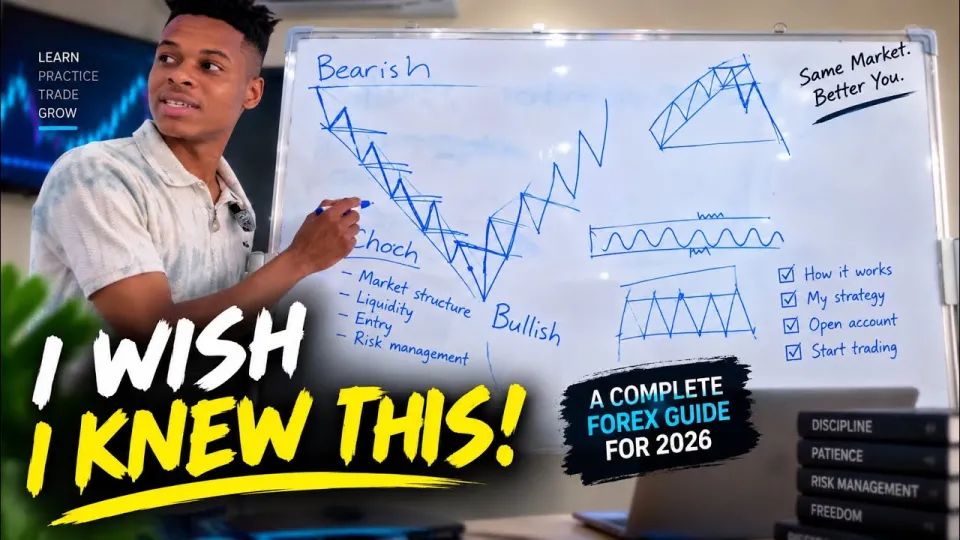
Video: How To Start Forex Trading For Beginners in 2026 (Full Guide + My Strategy)
Want articles like this for your own video to promote it on YouTube and Google? Order them through the Telegram bot @sat_sit_bot. Articles with your video embedded are written and posted by the bot itself — on popular topical sites (no ads). Try it free: 50 articles on us.
Key takeaways
- Forex is an over-the-counter market where currencies are quoted in pairs such as EUR/USD, and retail traders speculate on price changes rather than buying physical currency.
- Start on a demo account, then fund a small live account only after you can follow one written strategy for at least 20–30 trades without breaking your rules.
- Market structure — higher highs and higher lows versus lower highs and lower lows — is the first chart skill to learn before any indicator.
- Risk per trade should stay at 1–2% of account equity, with a stop loss placed before the entry, not after.
- Carl Fx, the author of the guide this article is based on, owns TFC Global Markets, the brokerage he promotes for account opening.
Forex trading for beginners in 2026 means learning one currency pair, one chart timeframe and one rule-based setup before risking real money — and the fastest route is a demo account at a regulated broker followed by a small live account. You do not need a large deposit or a complex indicator stack to start; you need a written plan, a stop loss on every trade and the discipline to repeat the same process. The guide below follows the structure of Carl Fx's beginner walkthrough and adds the practical detail you need to act on it, including where to open a trading account with TFC Global Markets.
What forex trading actually is and how the market works
Forex is the global market for exchanging currencies, and retail traders almost never take delivery of currency — they speculate on the price of one currency against another, quoted in pairs like EUR/USD, GBP/USD or USD/JPY. When you buy EUR/USD you are effectively long the euro and short the dollar, and your profit or loss is the change in that ratio multiplied by your position size.
The market runs 24 hours a day from Monday morning in Asia to Friday evening in New York, with the deepest liquidity during the London and New York sessions. There is no central exchange: trading happens over the counter through a network of banks, brokers and liquidity providers, which is why your broker's spread, execution and regulation matter as much as your analysis. Prices are moved by interest-rate decisions, inflation data, employment reports and risk sentiment, so a beginner should know the economic calendar before placing any trade.
Leverage is the feature that attracts most newcomers and hurts them fastest. A 1:100 leverage ratio lets a $500 account control $50,000 of currency, which means a 1% move against you can wipe out the entire balance. Treat leverage as a tool for capital efficiency, not as a way to trade bigger than your account can survive.
How to open your trading account step by step
Opening an account is a 15-minute administrative task, and the real work is choosing the broker and the account type correctly. Work through these steps in order:
- Check regulation. Look for a licence from a recognised authority (FCA, ASIC, CySEC or an equivalent) and read the client-funds policy.
- Compare costs. Spreads on EUR/USD should be tight during London hours, and you should understand swaps, commissions and any inactivity fees.
- Register and verify. You will need ID, proof of address and, for a live account, a payment method in your own name.
- Start on demo. Use the same platform and the same strategy you intend to trade live, for a minimum of one to three months.
- Fund small. A first live deposit of $100–$500 is enough to test execution and psychology without turning a learning phase into a financial loss.
Carl Fx promotes TFC Global Markets, a brokerage he states he owns, as the account he uses; the sign-up link is in the first paragraph of this article. Ownership disclosure is worth noting because a broker recommendation from an owner is marketing as well as education — verify the entity's regulation yourself before depositing.
Reading bullish and bearish markets through market structure
Market structure is the skeleton of price action: an uptrend prints higher highs and higher lows, a downtrend prints lower highs and lower lows, and a range prints neither. Before you draw a single indicator, mark the last three swing highs and swing lows on a daily or four-hour chart and label the sequence. If the most recent swing low was broken, the bullish structure is gone regardless of what your moving average says.
Price action then gives you the trigger. A simple beginner-friendly model is the break-and-retest: price breaks a swing high in an uptrend, pulls back to the broken level, and shows a rejection candle such as a pin bar or engulfing pattern. You enter on the rejection, place the stop below the swing low, and target the next structure level or a multiple of your risk. The same logic inverted applies to shorts.
Timeframes should be layered, not mixed randomly. Pick a higher timeframe for direction (daily or four-hour), a middle timeframe for the setup (one-hour), and a lower timeframe only for entry refinement. Beginners who flip between the one-minute and the weekly chart in the same session usually end up with contradictory signals and no repeatable process.
A simple beginner strategy you can practise this week
The strategy matters less than the consistency of applying it, so pick one pair — EUR/USD is the most liquid and the cheapest to trade — and one setup. A workable framework looks like this:
- Direction filter: only take longs when the four-hour structure is bullish, only shorts when it is bearish.
- Entry zone: wait for a pullback into a broken structure level or a clearly marked support/resistance zone.
- Trigger: a bullish or bearish rejection candle closing inside the zone.
- Stop loss: beyond the swing that created the zone, never wider than your risk budget allows.
- Target: the next opposing structure level, with a minimum reward-to-risk of 1:2.
- Review: screenshot every trade and note whether you followed the rules, not whether you won.
Risk per trade should be 1–2% of equity. On a $500 account that is $5–$10 of risk, which is small in absolute terms and exactly the point: the first hundred trades are tuition, and the goal is to survive them with your capital and your process intact. Journal the pair, session, setup grade and outcome for every entry.
Common mistakes beginners make in their first months
Most beginner losses come from process failures rather than bad analysis, and the same handful of errors repeat across accounts. The most expensive is trading without a stop loss or moving it further away when price approaches it. The second is oversizing after a win, which turns a good week into a single catastrophic trade. The third is revenge trading after a loss, which usually produces two or three more losses in the same hour.
Other traps worth naming: switching strategies after two or three losing trades, trading during major news releases without understanding slippage, following unverified signal groups, and confusing a demo account's frictionless results with live conditions where spreads widen and orders fill differently. A beginner who risks 1% per trade, avoids high-impact news in the first month and keeps a written journal is already ahead of most of the retail crowd.
Questions beginners ask before their first trade
Many viewers of beginner forex guides are ready to start but stuck on practical details, and a few themes come up again and again. The first is whether a demo account is worth the time — it is, because it lets you test the mechanics of order placement, stop losses and position sizing without paying for the lesson. The second is how much capital is needed: there is no universal minimum, but a deposit small enough that a losing month does not change your life is the right size.
The third recurring question is whether a beginner can learn from free content alone. Free material is enough to learn structure, risk management and one setup, but it requires filtering: prefer educators who show losing trades, state their risk model and disclose commercial interests. The fourth theme is patience — most people who quit forex do so in the first six months, usually because expectations of quick income met the reality of a skill that takes hundreds of chart hours to develop.
Useful links
- Open a trading account with TFC Global Markets — the brokerage promoted in the Carl Fx guide, which the channel owner states he owns.
- Carl Fx free Telegram community — the channel's free group for charts, questions and trade discussion.
Bottom line on starting forex in 2026
Forex is a learnable skill, but it is a skill measured in months and hundreds of trades, not in a weekend course. Start with market structure on a daily chart, one pair, one setup and 1–2% risk, and let a demo account absorb your early mistakes. When you do go live, register with TFC Global Markets through the Carl Fx link only after you have checked the entity's regulation and read the risk disclosure yourself. The guide this article is built around comes from the Carl Fx channel, which covers trading, discipline and personal growth for beginners; treat every broker recommendation, including the channel owner's own, as something to verify rather than accept.
Questions & answers
How much money do I need to start forex trading?
There is no fixed minimum, but a first live deposit of $100–$500 is common because it is enough to test execution and psychology without causing real financial damage. With 1–2% risk per trade, a $500 account risks $5–$10 per position, which is deliberately small. The correct amount is whatever you can afford to lose entirely while you learn.
Is a demo account enough before trading real money?
A demo account teaches order mechanics, position sizing and platform navigation, but it cannot replicate the emotional pressure of real money or live slippage and spread widening. Use demo for one to three months with the exact strategy you plan to trade live, then move to a small live account rather than staying on demo indefinitely.
How long does it take to become consistently profitable?
Most traders need hundreds of chart hours and a few hundred logged trades before their results stabilise, which usually means six to eighteen months of deliberate practice. Progress depends less on the strategy than on journaling, fixed risk and the discipline to repeat one process. Anyone promising fast profits is selling something other than a skill.
Should I follow a broker recommendation from a YouTube trading channel?
Verify the broker's regulation, client-funds policy and costs independently, and note whether the educator owns or is paid by the broker — Carl Fx states he owns TFC Global Markets, the brokerage he promotes. Ownership does not automatically make a broker unsuitable, but it makes the recommendation marketing as well as education. Open a demo account first and test execution before depositing.
Source: How To Start Forex Trading For Beginners in 2026 (Full Guide + My Strategy) · Markdown version